Showing posts with label Why I like.... Show all posts

Saturday, June 27, 2009

Why I like Mutant Future


Okay, this'll be my last review in a while, so I'll make it good.


Science Fiction Role-Playing Game of Mutants, Ruins, and Radiation

  • Idea- Most of us are familiar with the traditional pseudo-medieval/magical campaign worlds, and indeed, there are plenty of systems to play these in. But what we don't have is a plethora of new ideas for other worlds. Even though Mutant Future is somewhat of a retro-clone (in this case, it simulates the TSR game Gamma World), it still uses an relatively uncommon idea for a setting - in this case, a post-apocalyptic world where nearly everything has been mutated by high doses of radiation.
  • Compatibility- As it boasts on the cover, Mutant Future uses game mechanics that are quite similar to most retro-clones, especially Labyrinth Lord (the similarity is no coincidence - the same person wrote both games). There's even a section in the back that shows how to convert the two games!
  • Monsters- Easily showing the versatility of the game system, Mutant Future offers practically 50 pages of monsters to choose from - and many are transported straight form the pages of Labyrinth Lord. The Purple Worm, Brain Lasher (AKA Mind Flayer), Green Slime, Yellow Mold, and many other monsters hail straight from the pages of old-school D&D, and it's easy to convert more - you hardly have to change anything!
  • Mutations- The large lists of possible character mutations takes up 14 full pages, giving mutated characters a wide variety of possible abilities and appearances. These range from the useful (natural weapons) to the annoying (prey scent) to the almost disabling (defective second brain) to the incredibly powerful (killing sphere). Even plants get their own mutations!
  • Technology- The range of pre-apocalyptic technology available as treasure is fascinating. Considering that the game is set in a period where medieval levels of tech are predominant, even a simple black powder rifle can be a huge advantage. The levels rise quickly, from assault rifles to gauss pistols to plasma cannons to powered armor. The Mutant Future campaign will not be lacking for treasure.
In summary, Mutant Future is a well-designed game system that will result in many happy hours for gaming groups everywhere.

Well, this is my last post for at least 4 weeks. See ya!

Sunday, June 14, 2009

What I like about The Simple Game System

For today's review, I'd like to select a somewhat unusual offering... The Simple Game System by Chris Gonnerman.

This little gem started off as a thread on the Dragonsfoot forums by Solomoriah (AKA Chris). It was an idea for a very rules-light system based on several "abilities" like Strength, Charming, and Agile. The idea was that you wouldn't have a number for the score... you just had the ability, or you didn't. It later expanded into a core mechanic (roll a number of dice equal to your ability (disability=0, nothing=1, ability=2, very ability three) and compare it to your opponent's (or a challenge, like opening a door) score), a skill system, and a combat system, which completed the game.

When I downloaded this for the first time, I was amazed by the clarity yet functionality of these rules. I quickly modified some magic rules written by Luigi Castellani and sent them in. A little while later, they appeared as the first supplement for the game. Now, another supplement has been written, this time on space rules.

Here are a few things I like about this system:
  • Simplicity yet functionality- There are 4 pages of rules for the entire system, and each of the supplements covers 2 pages. This is not a rules-heavy game, yet there's a way to adjunct nearly any situation quickly and easily.
  • Rules only for what needs rules- Unlike many other RPGs, this one does not include any rules covering alignment or money transactions. This information is going to vary from campaign to campaign, so for a system as broad as this, there's really no point in recording that information.
  • Abstractness- In some games, there are detailed rules for hit location, and a character's height and weight must be known. In this one, all weapons do the same amount of damage (there isn't even hit points) and any specific factor must be decided by the GM.
  • Universality- I recently ran a TSGS game where one player was a robot- and not even a human-like one. This game can handle practically anything.
Well, that's why TSGS is one of my games of choice. I encourage you to try it - you might like it!

Friday, June 12, 2009

What I like about some other Retroclones


Now that I've covered OSRIC and BFRPG in my series on retroclones, here are a few comments for other 'clones, even if I haven't read them thoroughly yet.

The great bit about this ruleset is it's simplicity. I can make a character in 5 minutes, and less if I pick simple equipment. Monsters have about 5 stats (characters have about 8), and even those don't matter much, as thinking is emphasized over rules.


These have a large emphasis like the White Box, but the coolest thing about them is th
eir mass combat system. It's easy to understand and use, and I plan to adapt it to BFRPG when I need to run a big battle.

I haven't played this personally, but giving it a quick read-through the best thing about it is the amount of campaign material. It has a dungeon, a small outline for a dungeon, and a "worldmap" with major locations noted. It seems like Brave Halfling Publishing has put this to good use, having written several modules for use in this world.

Okay, keep a lookout for Part Two, including Mutant Future, Spellcraft and Swordplay, and Mazes and Minotaurs.

Sunday, May 24, 2009

Why I like BFRPG

Second in my series on my favorite Retro Clones, I've decided to review BFRPG. Here's why I like it:


BFRPG

Basic Fantasy Role-Playing Game

Ease of Use- BFRPG is one of the simplest yet functional RPGs I've seen in a long time. The easy mechanics and basic options are quite easy to use, yet they give a very firm base to the game. There are only 4 classes - Fighter, Cleric, Magic User, and Thief - and yet you can create almost any archetype imaginable. The rules for combat are short and orderly as well, yet they cover almost any possible situation. A quick section on optional rules allows the GM to make his or her preferred changes to the game through a "canon" base, and gives newer GMs an opportunity to experiment with changing the rules. These flexible yet solid rules provide an excellent base to work from.

Modern Ideas- While taking cues from the original (before Advanced) version of D&D, BFRPG is based in part on the 3.5 SRD. Some grognards will laugh at me for saying this, but there are actually a lot of new, good ideas out there. BFRPG takes the best of these (such as ascending armor class) and incorporates them into its system flawlessly. These new ideas make the game attractive to players of third and fourth edition who are looking for something different, as well as making it distinct from games that directly clone OD&D.

Community- BFRPG was based on Chris Gonnerman's ideas, but was shaped immeasurably by the Dragonsfoot community. The rules have thus gone through countless revisions, so many that I can not find an error in the core rules yet! Also, the community is devoted to churning out countless modules and supplements (see next reason).

Resources- There are, I believe, 21 free, fan-created rules supplements (counting the articles in the Old Dungeoneer's Almanack) on the BFRPG downloads page. There are also 11 modules (three of which include several separate adventures and one which includes a sketch of a campaign world and a "home base"). Finally, there are 9 character sheets (one of which comes in 5 different languages) and four DM sheets (including a spreadsheet of all the monsters available so far). BFRPG is also compatible with great, old school modules like Keep on the Borderlands (of which a homage version is also available on the site).

Art- The art in the BFRPG core book is as good as any I have seen so far (in a RPG book, at least). The giants (by Luigi Castellani) and the Stirge and Shrieker (by Andy "ATOM" Tailor) are especially great.

Well, those are my high points of BFRPG! What do you think?

Monday, May 18, 2009

Why I like OSRIC

To start off my blog, I've decided to go through my favorite retro clones and explain what's so great about them. Without further ado, here's the review for OSRIC.

OSRIC


Old School Referencing and Indexing Compendium


  • Style- OSRIC is meant to simulate the first incarnation of AD&D, and it does so incredibly well. The writing style, while not copied from either the SRD or AD&D 1e, manages to be incredibly old-school while simultaneously explaining everything well.

  • Organization- OSRIC manages, amazingly, to bring the best of AD&D with it while making it easy to learn. There are 6 chapters with a few appendices (which, amazingly enough, do not contain vital information). The chapter list is as follows:

  • Creating a character- This gives the standard information on abilities, races, classes, alignment, and equipment (which actually gives the encumbrance amounts).

  • Spells- The standard AD&D spells are contained here, as are a few notes concerning their use. I was impressed by the hyperlinks and inclusion of all the spells, but was disappointed to still see the "hole" in Prismatic Spray.

  • How to Play- This chapter is where OSRIC really starts to shine. All the information for encumbrance and movement, XP charts, adventuring rules (like light and falling), combat and related rules, morale, hirelings and henchmen (which were left out by an error that will be corrected in the print version), and even a sample dungeon, just like the one in the DMG.

  • Dungeons, Towns, and Wildernesses- This is probably the best (somewhat new) part of OSRIC. It only contains two parts, but they're amazing. The dungeon generator is quite similar to the one found in Appendix A of the DMG, but contains excellent drawings of new starting areas. The other highlight of this chapter, which was not noticed by me until recently, is the encounter tables, and they are simply amazing. Not only does it incorporate most of the monsters from the original Monster Manual, Fiend Folio, and Monster Manual II, it contains amazingly creative tables to fit any DM (or OSRIC GM)'s needs. The dungeon and town encounter tables are good, but even better are the wilderness tables, which cover a host of situations (Graveyard and Lost World) and monsters (there is a one in one thousand chance of meeting a Xorn in a forest). If I were to only keep one chapter from OSRIC to use in my regular AD&D game, I would pick this one.

  • Monsters- This chapter is probably second best to #4. It collects most of the monsters from the Fiend Folio (especially important for me as I don't have a copy) and Monster Manuals. There are a few new options and ideas presented that sound intriguing (an Effective Level for monsters and giant shamans getting Illusionist spells), but the meat is in the monsters. They're organised by type, which is an improvement over anything I've seen so far, and have excellent illustrations (look at the Demons and Devils if you don't believe me).

  • Magic Items- This chapter isn't really much, as it collected some of the appropriate items from the SRD and dumped them here. There was one idea I liked from d20, though... organising artifacts into "Major" and "Minor" categories, and dumping some of the more powerful items like the Staff of the Magi into the Minor category. Overall, though, I was expecting more.

  • The Appendices are also useful, though nothing to write home about. There are some Collected Charts and Tables, and a (rather boring) character sheet.Overall, though, OSRIC is incredibly organised, and I like it that way.

  • Formatting- OSRIC is very well made and easy to read. The page numbers are watermarked, and the green shading makes the tables particularly nice, as well as setting the tone. However, it comes out quite well when printed in black and white.

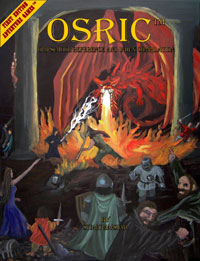
  • Art- OSRIC attracted several incredible artists, and the vast number of nice pieces attests to this, as well as giving the work a great old-school feel. The cover art sets the mood nicely, and the "spread" pieces covering one or two pages provide a great way to divide chapters.

  • Support- OSRIC was originally built to be a framework for publishers to publish AD&D compatible modules and supplements. There is a huge number of modules out there, including nine (and counting) in the Advanced Adventures series by Expedious Retreat Press. Also published are several supplements, including Monsters of Myth by some of the game's authors.

Well, those are the main reasons why I like OSRIC. What are yours?