OSRIC (Old School Referencing and Indexing Compendium) is now out on Lulu! This has been coming for a long time, but was delayed when Stuart Marshal, AKA PapersandPaychecks (the editor and co-creator of the game) had a few Real Life problems. The game is available in four forms:
Hardcover Black and White- $28.80
Paperback- $15.70
Economy- $10.90
Hardcover Color- $98.20
I'm pretty sure that "economy" has cheaper paper than "paperback".
If anyone orders one of these, let me know and send a picture!
Showing posts with label OSRIC. Show all posts
Showing posts with label OSRIC. Show all posts
Monday, June 8, 2009

Sunday, May 31, 2009
A bit about the games I run
Here's a list of the games I'm currently D/GMing:
- Allakee Playtest: This is my current RPOL (an online service that allows Play-by-Post games) game. I'm playtesting Allakee, the module I'm writing for OSRIC. It's a bit like Hommlet, except it doesn't fit into a certain storyline (like the Temple of Elemental Evil does). The characters are currently investigating an abandoned tower (play-by-post moves very slowly).
- Morgansfort: This is a one player, one DM BFRPG game with one of my friend's children (a fourth grader). We're playing through the Old Island Fortress at the moment, and it's about half cleared out. Recently, the player collected some giant bee honey and sold it in Slateholm, which I thought was a great opportunity to introduce a merchant that plays a part in the Cave of the Unknown.
- The Chaotic Caves: This was originally a one-off of the BFRPG homage to Keep on the Borderlands, but I've introduced it whenever I have some D&D players over my way.
Also, here are a few that I have DMed before:
- White Plume Mountain: Our group (middle school) played through this recently, and it was a blast! They got all three weapons, and... killed the owners. What an anticlimax. Of course, I made a mistake and allowed the Plaldin to play Lawful Stupid...
- The City of Kobolds: An entire villiage was captured and taken into the Underdark by kobolds! The players fouught their way out in a gladitorial exacution, taming a Learnan Hydra along the way, and were about to regin the surface world with what was left of the village, when the game died out.
Monday, May 18, 2009
Why I like OSRIC
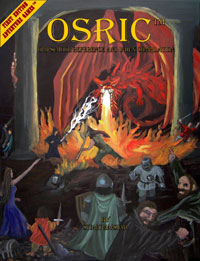 To start off my blog, I've decided to go through my favorite retro clones and explain what's so great about them. Without further ado, here's the review for OSRIC.
OSRIC
Old School Referencing and Indexing Compendium
- Style- OSRIC is meant to simulate the first incarnation of AD&D, and it does so incredibly well. The writing style, while not copied from either the SRD or AD&D 1e, manages to be incredibly old-school while simultaneously explaining everything well.
- Organization- OSRIC manages, amazingly, to bring the best of AD&D with it while making it easy to learn. There are 6 chapters with a few appendices (which, amazingly enough, do not contain vital information). The chapter list is as follows:
- Creating a character- This gives the standard information on abilities, races, classes, alignment, and equipment (which actually gives the encumbrance amounts).
- Spells- The standard AD&D spells are contained here, as are a few notes concerning their use. I was impressed by the hyperlinks and inclusion of all the spells, but was disappointed to still see the "hole" in Prismatic Spray.
- How to Play- This chapter is where OSRIC really starts to shine. All the information for encumbrance and movement, XP charts, adventuring rules (like light and falling), combat and related rules, morale, hirelings and henchmen (which were left out by an error that will be corrected in the print version), and even a sample dungeon, just like the one in the DMG.
- Dungeons, Towns, and Wildernesses- This is probably the best (somewhat new) part of OSRIC. It only contains two parts, but they're amazing. The dungeon generator is quite similar to the one found in Appendix A of the DMG, but contains excellent drawings of new starting areas. The other highlight of this chapter, which was not noticed by me until recently, is the encounter tables, and they are simply amazing. Not only does it incorporate most of the monsters from the original Monster Manual, Fiend Folio, and Monster Manual II, it contains amazingly creative tables to fit any DM (or OSRIC GM)'s needs. The dungeon and town encounter tables are good, but even better are the wilderness tables, which cover a host of situations (Graveyard and Lost World) and monsters (there is a one in one thousand chance of meeting a Xorn in a forest). If I were to only keep one chapter from OSRIC to use in my regular AD&D game, I would pick this one.
- Monsters- This chapter is probably second best to #4. It collects most of the monsters from the Fiend Folio (especially important for me as I don't have a copy) and Monster Manuals. There are a few new options and ideas presented that sound intriguing (an Effective Level for monsters and giant shamans getting Illusionist spells), but the meat is in the monsters. They're organised by type, which is an improvement over anything I've seen so far, and have excellent illustrations (look at the Demons and Devils if you don't believe me).
- Magic Items- This chapter isn't really much, as it collected some of the appropriate items from the SRD and dumped them here. There was one idea I liked from d20, though... organising artifacts into "Major" and "Minor" categories, and dumping some of the more powerful items like the Staff of the Magi into the Minor category. Overall, though, I was expecting more.
- The Appendices are also useful, though nothing to write home about. There are some Collected Charts and Tables, and a (rather boring) character sheet.Overall, though, OSRIC is incredibly organised, and I like it that way.
- Formatting- OSRIC is very well made and easy to read. The page numbers are watermarked, and the green shading makes the tables particularly nice, as well as setting the tone. However, it comes out quite well when printed in black and white.
- Art- OSRIC attracted several incredible artists, and the vast number of nice pieces attests to this, as well as giving the work a great old-school feel. The cover art sets the mood nicely, and the "spread" pieces covering one or two pages provide a great way to divide chapters.
- Support- OSRIC was originally built to be a framework for publishers to publish AD&D compatible modules and supplements. There is a huge number of modules out there, including nine (and counting) in the Advanced Adventures series by Expedious Retreat Press. Also published are several supplements, including Monsters of Myth by some of the game's authors.
Well, those are the main reasons why I like OSRIC. What are yours?
Subscribe to:
Posts (Atom)


